In Russia and Turkey, tea is everyday life. Both cultures traditionally brew a strong concentrate and dilute it with hot water — though their tools and traditions differ.
This article draws on Wikipedia's articles on the samovar, Russian tea culture and tea in Turkey.
- Samovar: "self-brewer"
- First documented makers: the Lisitsyn brothers, Tula, 1778
- Zavarka: strong tea concentrate, diluted about 10:1
- Turkey: highest per-capita tea consumption
- Turkish tea: mostly from Rize Province
The samovar
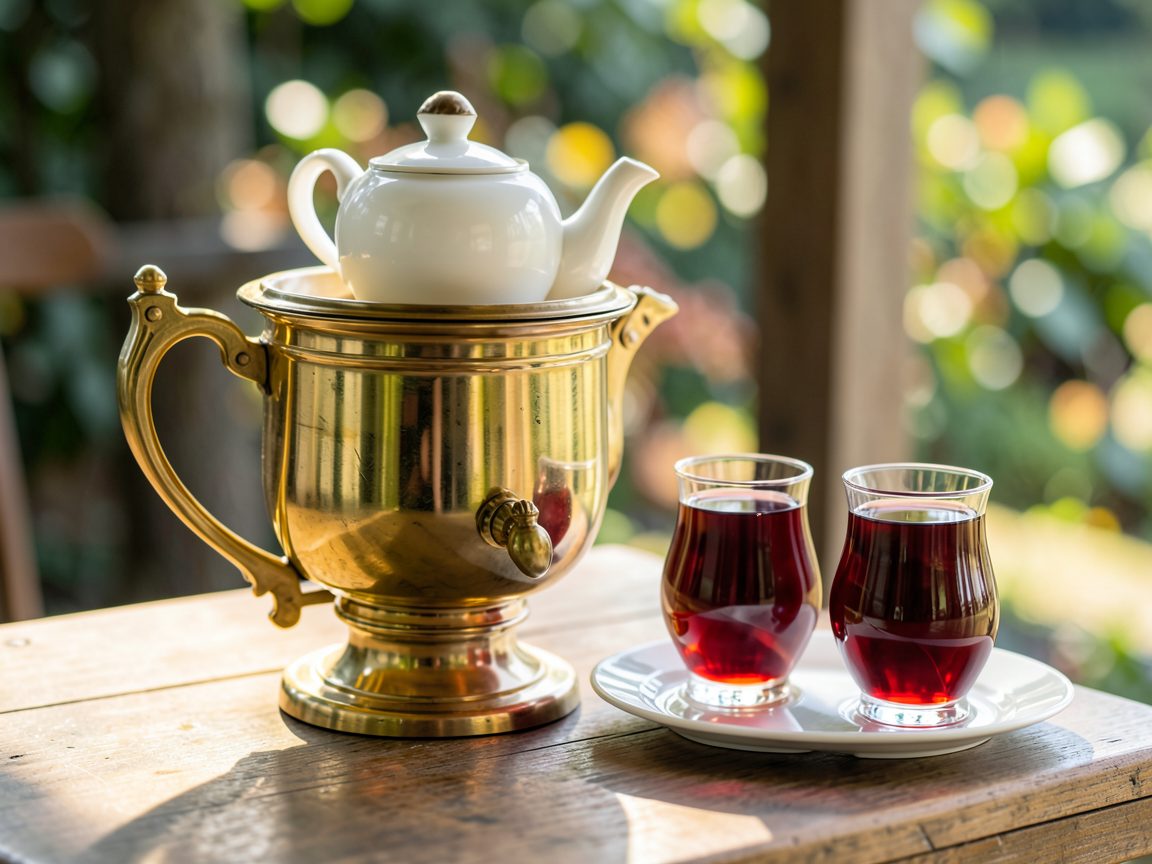
A samovar (literally "self-brewer") is a metal container traditionally used to heat and boil water. Many have a ring on top to hold and heat a teapot of tea concentrate called zavarka. Tea is served by diluting the zavarka with boiled water from the samovar, usually at a water-to-tea ratio of about 10 to 1, adjusted to taste.
- Traditional samovars were heated with coal or kindling in a central pipe; many newer ones are electric.
- The first documented samovar makers were the Lisitsyn brothers, who made a samovar in 1778 and registered a samovar factory the same year in Tula, a city famed for metalworking.
Tea in Russia
Wikipedia describes tea as Russia's de facto national beverage. Key moments in its history:
- A popular legend of Russians first meeting tea in 1567 is generally considered by historians to be fictional.
- Tea arrived as a diplomatic gift from a Mongolian ruler to the Tsar around 1636–1638.
- From 1689 the "Tea Road" carried tea between Russia and China by camel caravan.
- The Trans-Siberian Railway reduced tea's journey from 16 months to seven weeks.
The samovar was widely used to boil water for tea until the mid-20th century.
Tea in Turkey
According to Wikipedia, Turkey has the highest per-capita tea consumption in the world, at over 3 kg per person per year — almost four glasses a day.
- Most Turkish tea is Rize tea, grown in Rize Province on the eastern Black Sea coast.
- Tea drinking was encouraged as an alternative to coffee, which became expensive after the end of the Ottoman Empire.
- Early cultivation experiments in Rize began in 1912; a Central Tea Nursery distributed seedlings from 1924.
- Tea houses and tea gardens play a big role in Turkish social life.
Brew it strong, dilute it to taste — a shared idea across Russian and Turkish tea.
Trying the style at home
The concentrate-and-dilute method can be tried with any strong black tea: brew a small, strong pot, then pour a little into each glass and top up with hot water to suit each person's taste.