Few kitchen inventions are as familiar as the tea bag. But what is actually inside one, and is it really so different from loose-leaf tea?
This guide draws on Wikipedia's articles on the tea bag and tea leaf grading.
- First patent: 1903 (filed 1901) in the USA
- Commercial success: about 1908
- Heat-sealed paper bag patented: 1930
- Rectangular bag: 1944
- Usually contains: fannings
A short history of the tea bag
- 1903: Roberta Lawson and Mary McLaren of Milwaukee, Wisconsin, were granted a US patent for a "Tea Leaf Holder", filed in 1901.
- Around 1908: tea bags were successfully marketed by Thomas Sullivan, a New York tea and coffee importer, who shipped silk tea bags around the world. A popular legend says customers were meant to empty the bags but found it easier to brew with the tea inside.
- 1929: the first automatic tea-bag packing machine was invented.
- 1930: the heat-sealed paper-fibre tea bag was patented by William Hermanson.
- 1944: the now-common rectangular tea bag was invented; before then, bags resembled small sacks.
What's inside a tea bag?
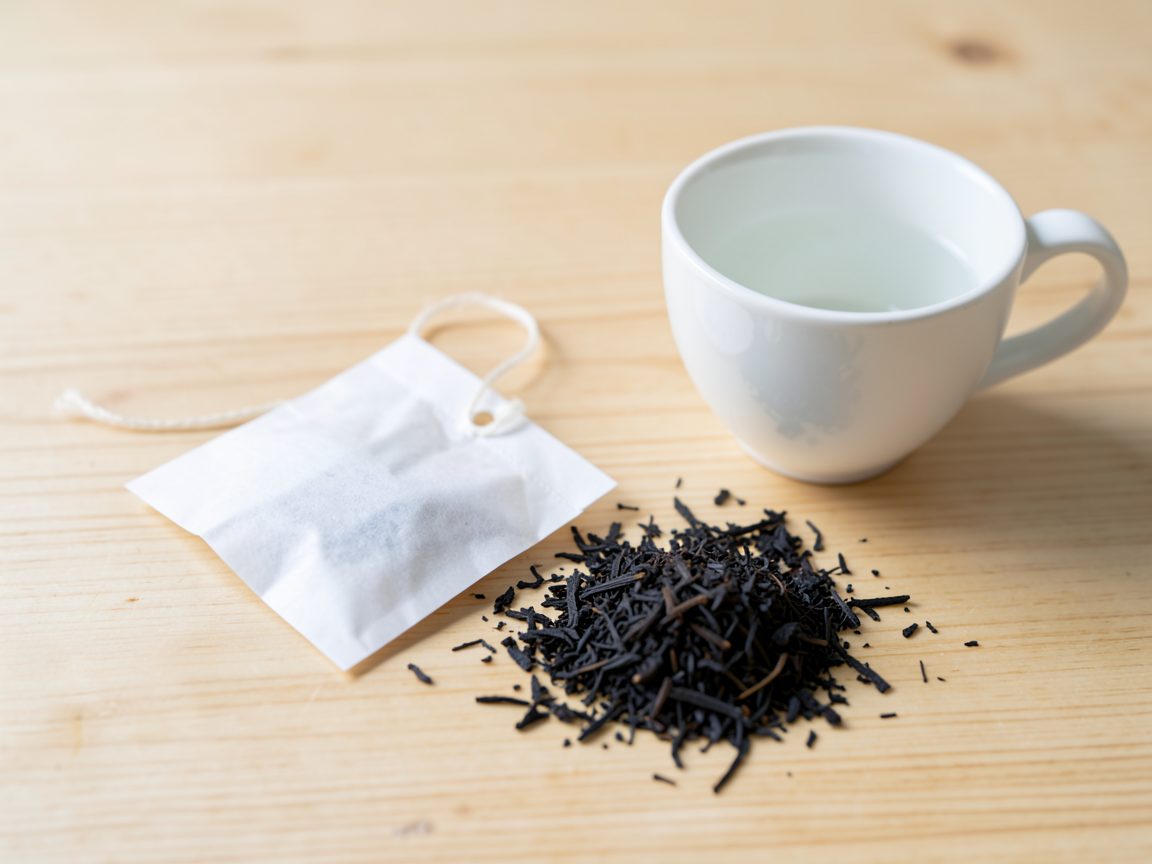
According to Wikipedia, tea bags typically contain fannings — small pieces of tea left over after larger leaf pieces are gathered for sale as loose tea. Some companies sell tea bags containing whole-leaf tea.
Fannings are considered among the lowest grades, but Wikipedia notes that the fannings of expensive teas can still be more expensive and more flavourful than the whole leaves of cheaper teas. Small particles brew quickly and strongly — which is also why CTC tea suits bags (see Orthodox vs CTC).
Pyramid bags
Tetrahedral (pyramid) tea bags were introduced in 1997. Wikipedia notes they are typically made of nylon, PLA mesh made from corn starch, or silk. Their extra space is often promoted as giving leaves more room to expand.
Materials and plastics
Traditional tea bags are usually made of filter paper. Wikipedia notes that some bags include a heat-sealable plastic such as polypropylene in their fibre, which means they are not fully biodegradable. A 2019 study cited by Wikipedia found that steeping a single plastic tea bag at 95 °C released billions of micro- and nanoplastic particles into the cup. If this concerns you, check the packaging for the bag material, or choose loose leaf.
Tea bags vs loose leaf
| Tea bags | Loose leaf | |
|---|---|---|
| Convenience | Very convenient; no infuser needed | Needs a teapot, infuser or strainer |
| Typical contents | Usually fannings; sometimes whole leaf | Whole or broken leaf grades |
| Brewing | Small particles brew quickly | Larger leaves need longer steeping |
| Choice | Limited to what's bagged | Wider range of grades and origins |
Wikipedia also mentions empty, fill-your-own tea bags, which combine the convenience of a bag with the choice of loose-leaf tea.