Ceylon cinnamon is made from the thin inner bark of Cinnamomum verum. According to Wikipedia, all the work is done by hand by experienced workers — the most expensive part of producing the spice.
This article draws on Wikipedia's articles on Cinnamomum verum and cinnamon.
- Grown as: leafy bushes, up to about 3 m
- First harvest: at about 3 years; productive 40–50 years
- Part used: inner bark only
- Tools: brass rod and brass or steel knife
- Finest grade: Alba, under 6 mm across
Growing
Cinnamomum verum is an evergreen tree native to Sri Lanka that can grow 10–15 m tall in the wild. In cultivation, the trees are grown as leafy bushes, usually reaching a maximum of about 3 m. They are first harvested at about three years old and continue producing well for 40–50 years.
Wikipedia's cinnamon article explains that the tree is coppiced — cut at ground level — and the following year about a dozen new shoots grow from the roots.
Harvesting and peeling
- Cutting: small side branches, 1.5–5 cm in diameter, are removed.
- Scraping: the outer bark is removed (and processed into mulch).
- Loosening: the inner bark is loosened by rubbing with a brass rod.
- Peeling: the bark is split with a brass or stainless steel knife and peeled off as intact as possible. Long, full quills are more valuable than broken pieces.
- Drying: the quills are dried over several days in the shade, then in darkness.
- Cutting to size: the dried bark is cut into sticks or ground into powder.
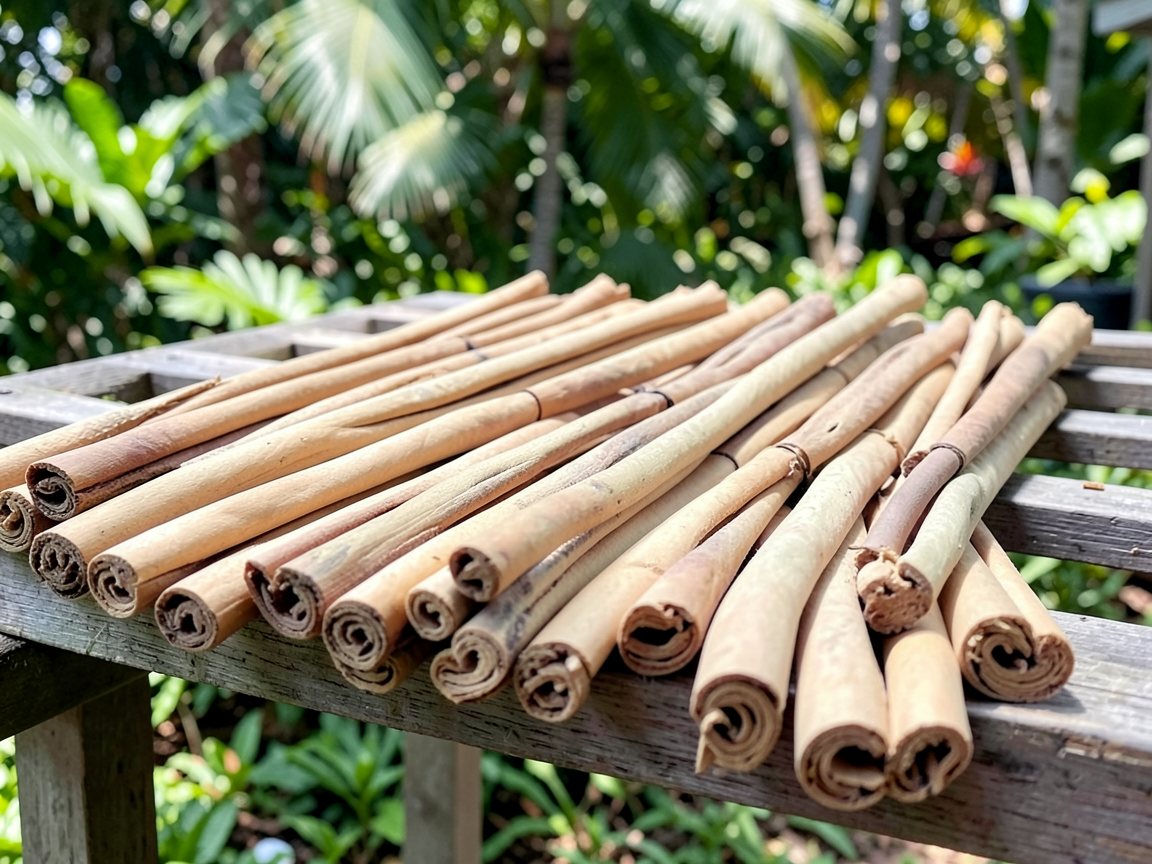
Wikipedia's cinnamon article adds that only about 0.5 mm of the inner bark is used, and that the strips curl into rolls — quills — as they dry. The twigs, leaves and seeds are crushed to make cinnamon oil, a less valuable by-product.
How quills are graded
The Sri Lankan grading system divides quills into four groups by diameter:
| Group | Diameter |
|---|---|
| Alba | Less than 6 mm |
| Continental | Less than 16 mm |
| Mexican | Less than 19 mm |
| Hamburg | Less than 32 mm |
These groups are divided further into specific grades. Pieces of bark shorter than 106 mm are sold as quillings; featherings are the inner bark of twigs and twisted shoots; and chips are trimmings and bark that can't be separated (Wikipedia).
Cultivars
Wikipedia lists several Sri Lankan cultivars named for the taste of their bark, including Pani-Miris Kurundu (sweet and spicy), Sewele Kurundu (smooth) and Thiththa Kurundu (bitter).
A traditional craft
Wikipedia's article on the Salagama community notes their traditional association with cinnamon peeling in Sri Lanka's southern coastal areas, going back centuries. See The Cinnamon Trade.
Half a millimetre of bark, peeled by hand and dried in the shade — that's a Ceylon cinnamon quill.